Pages

Showing posts with label 20th Century. Show all posts

Monday, 22 September 2014

Brave New World by Aldous Huxley

“One believes things because one has been conditioned to believe them.”

Brave New World by Aldous Huxley reminds me of a more disturbing and extreme version of 1984. The 20th Century novel is set in London in 2540 (in the book, known as 632 after Ford).  The world is stable; nobody ever suffers, the world is united, the people are happy and everyone is in a job that is satisfactory to them. However, this means controlling everything; the world has a stable population of 2 billion, children are ‘manufactured’ in labs, genetically modified to fit a caste and then educated – almost traumatized/terrorized – to fit into society. The lower castes (the majority of the population) are bred through a process in which one single egg produces up to 96 identical children. When Bernard and Lenina travel to the “Savage Reservation”, they are shocked at the difference between the two worlds. They end up encountering, John, a young man that was born from World State parents but born and raised in the Savage World. John is an outsider due to his appearance in the primitive village, and finds comfort in reading Shakespeare. Bernard decides to take John and his mother back to London. However, John finds the ‘civilized’ society appalling and is still feels as the outsider...
Friday, 12 September 2014

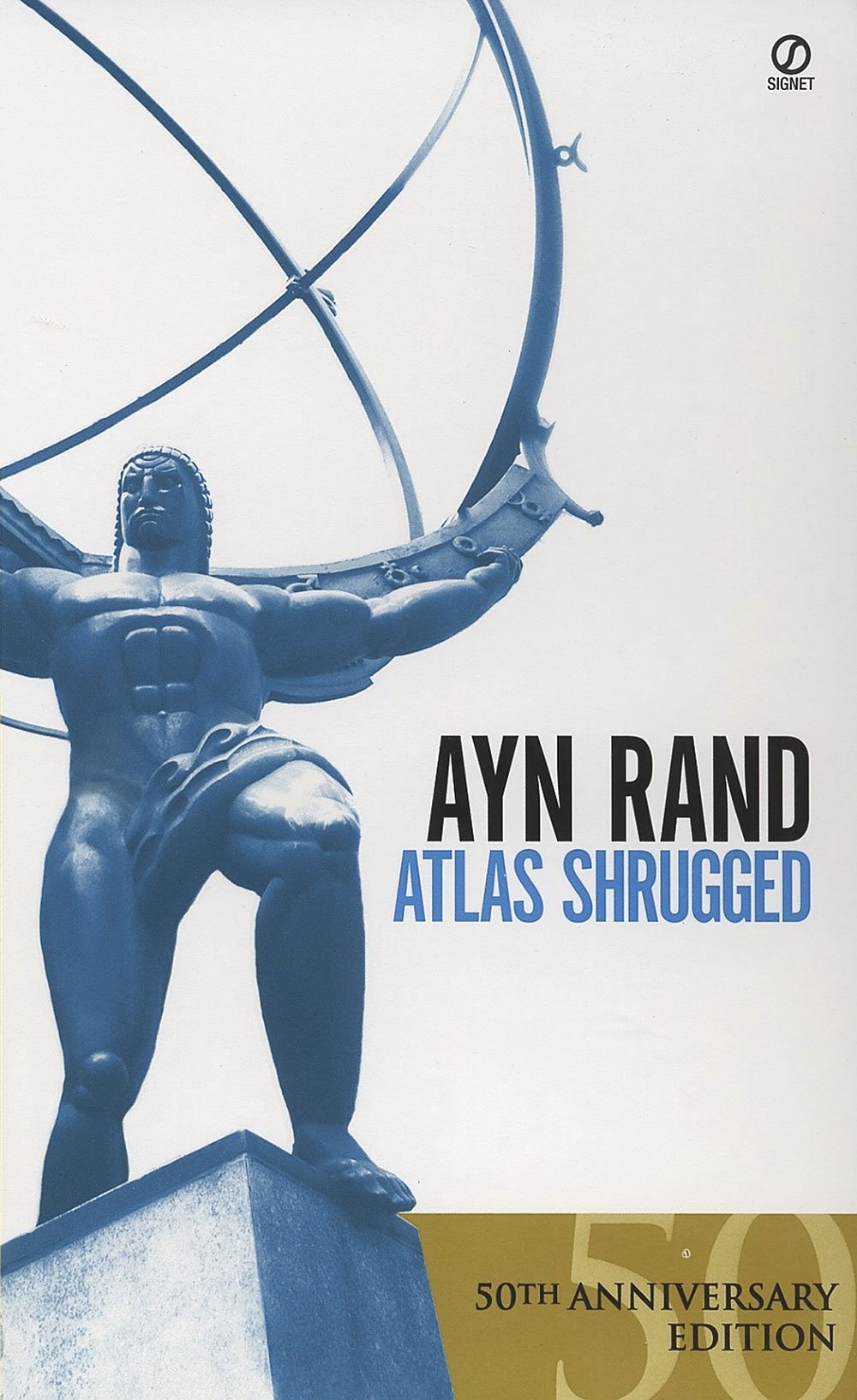
Atlas Shrugged by Ayn Rand

“I started my life with a single absolute: that the world was mine to shape in the image of my highest values and never to be given up to a lesser standard, no matter how long or hard the struggle.” 

“If you don't know, the thing to do is not to get scared, but to learn.” 

“It is not death that we wish to avoid, but life that we wish to live.” 

Atlas Shrugged by Ayn Rand is the story of the creative minds, the hard workers, the inventors protesting against the corrupt government and society. It is mostly told through Dagny Taggart’s (a railroad executive) point of view. She struggles to follow her moral code and love for her industry while having to sacrifice everything for a society/government that judges her as amoral; taking advantage of her virtues. John Galt becomes the symbol of everything she hates, but mostly everything she loves. Dagny finds a broken down motor which runs on static electricity, as she tries to find the inventor and his reasons for abandoning the motor she begins to find a whole new world and philosophy. Dagny is reluctant to give up her railroad but she begins to see that she is only helping the looters.

As you should be able to tell by my use of three quotes, I really liked the book and what it had to say. I had previously read, We the Living, and I had really enjoyed it so I decided to read another of Rand’s book. I must say, I have found that I really agree with Rand’s philosophy. There were a lot of teachers that did not support me reading this book, they thought it would ‘brainwash’ me; too extremist. I don’t think these teachers had completely read the book, because too me it wasn't just about being rich and selfish. Sure, it justified capitalism and some things were exaggerated; however, it talked about hard work, about only giving and taking what is deserved and about money being important but only the tool and not the means or the end.

Sunday, 16 March 2014

To the Lighthouse by Virginia Woolf

“He smiled the most exquisite smile, veiled by memory, tinged by dreams.” 

To the Lighthouse by Virginia Woolf is one of the most well known modernist books. The novel was written in a stream-of-consciousness style and it was set in three parts and the plot can be really quickly summed up with:


The Window: Mrs. and Mr. Ramsay with their children and guests spending time in their Scottish holiday home. Six-year-old James wants to go the lighthouse, his mother agrees but Mr. Ramsay states that the weather is not good enough for the boat journey. One of the guests, Lily Briscoe is painting. Paul Rayley and Minta Doyle (two guests) get engaged.
Time Passes: World War 1 breaks out and the house is left abandoned. Everyone dies... Jokes – it just felt like that. Mrs. Ramsay died suddenly, Andrew Ramsay (oldest son) dies in battle and Prue (daughter) dies after giving birth. (Note: the deaths are all told in brackets)
The Lighthouse: Mr. Ramsay with his children (those that are still alive) and two of his guests decide to go back to the house. Mr. Ramsay makes his children go with him to the Lighthouse. Lily goes back to painting and this time manages to achieve her vision.

Personally, the summary that I just gave was exactly what a whole 227 page novel spent describing. But, if you’ve read my review on Mrs. Dalloway, my lack of enthusiasm for Virginia Woolf wouldn’t be surprising. For me, I need a plot that I can invest myself in. However, one thing that I must give to Woolf is her sense of rhythm, like the repetitive and familiar lives of the Ramsays as the waves come and go in their island. Only when I went back to the introduction written by Hermione Lee in 1991 (it was included in the version I borrowed) that I realised how much of a difference her editing and style really made. Read the manuscript version to see for yourself:

Friday, 28 February 2014

Mrs. Dalloway by Virginia Woolf


"This late age of the world's experience had bred in them all, all men and women, a well of tears" 


Mrs. Dalloway by Virginia Woolf is written in a stream-of-consciousness form; as were many modernist literature. The story is set in only one day, as Clarissa Dalloway organizes a party. The story reveals her thoughts and ideas. It also explores the interwoven stories of Dalloway's friends and husband. The story is told in parallel with a War Veteran suffering from post traumatic stress disorder. Even though the veteran is quite disillusioned he shares Clarissa's feeling of oppression by society. 

Personally, I did not enjoy this book as much as I had hoped to. This is due to my own dislike of the usual modernist style. I much prefer structure and a full narrative. However, I do enjoy analyzing and breaking apart this style of story. The more you analyse the more little 'tricks' and ideas of life and society that were so subtly criticized/analysed are discovered.

Friday, 17 May 2013

The Great Gatsby by F. Scott Fitzgerald


“The loneliest moment in someone’s life is when they are watching their whole world fall apart, and all they can do is stare blankly.”The Great Gatsby by F. Scott Fitzgerald is a classic American novel. The story is told by Nick as he shares his point on view of the people around him and of course, about the mystifying Gatsby. Gatsby, like the country, is young. Gatsby’s past mysterious, his stories don’t match up and the reasons he has done everything so far is unclear. Nick uncovers the truth, or at least what we think is the truth, of the man.I guess if you are reading this you want to know if it is a good book to read. Before I start discussing the novel and analyzing it, I will start by answering this. I have heard many people who have enjoyed this book, it is even being made into a movie but I wouldn’t recommend it to anyone.

Tuesday, 7 May 2013

We the Living by Ayn Rand

File:AynRand WeTheLiving.jpg
“To a life; which is reason unto itself.”  - Ayn Rand

We the Living by Ayn Rand is set in the early 1900s in the uprise of communism in Russia. Although it is about the U.S.S.R. the story is still relevant (as Rand points this out, in her foreword) because it is about totalitarianism and how humans should never think them above anyone else to have the right to decide who lives and who dies, because it is those that are fighting for life that deserve it and make progress and those who kill or live for others have much to learn. The plot revolves around Kira, a young woman who returns to her family home in Petrograd. Kira is very passionate about life and living it for her own sake, she dislikes the communists and yet she dislikes their enemies, she prefers to live not for a group but for herself. Kira studies at the institute to become an engineer. At the institute she meets Andrei Taganov. Andrei is a strong proletariat but starts developing feelings for Kira. However, Kira falls in love with a handsome stranger she met in the park at night time. This is the story of her own battle and struggles that she faces to become the woman she always wanted to be.


This book was amazing! It was captivating and had a nice love story, and yet it still taught a lot about Russia at the start of the Communist movement. There were some parts that I wished for  a 'glossary' at the end of the book or at least notes to explain some terminologies, however, the overall book was not so hard to understand. Just if someone has troubles understanding, here are the words I got stuck at,

Thursday, 4 April 2013

The Case Book of Sherlock Holmes by Sir Arthur Conan Doyle

'You see, but you do not observe. The distinction is clear.'

Sherlock Holmes is a series of mystery and crime fiction books. Holmes is a consulting detective and Watson is his sidekick. Together, they solve crimes. Sherlock Holmes has a very strange personality. He is very intelligent and observant but isn't empathetic and usually doesn't say what his thoughts are about the crime only when he has solved everything.

Monday, 1 October 2012

Battle of Britain - Harry Woods, England 1939-1941 by Chris Priestley


Battle of Britain by Chris Priestley is part of the My Story series. This book is set in England during mid 20th Century. It is the life of a young man during World War II whose love for flying gets him to enlist for the RAF. 

This book really let me down. This review had a very short plot summary and will probably be a short review because really the plot felt short. The books in the My Story series are usually a short read, however this time the plot was so short that it just skipped on the details.