Pages

Showing posts with label dystopia. Show all posts

Monday, 27 November 2017

Fahrenheit 451 by Ray Bradbury


“The magic is only in what books say, how they stitched the patches of the universe together into one garment for us.” 

Fahrenheit 451 is a science fiction dystopian story about a world that has banned books. The world has become increasingly superficial. People are discouraged to think and ask questions. Television shows stimulate the senses and body rather than the brain. The protagonist is a firefighter, someone who burns books for a living. In the beginning, he is content in his life. But as he meets a very curious and unique seventeen-year-old girl, he begins to critically analyse. Through the course of the story, he starts to understand the importance of books in passing knowledge, philosophy and presenting to us both the good and bad in life, society and us.

Bradbury’s work for me was more of a poetic essay. A very short read, a very linear and simple plot but one that is heavily based on philosophy. A complete contrast to the world it presents in the book.  It shows that content ignorance, a world with no controversies, doesn’t lead to a happy life. As we see through the suicidal tendencies of Guy’s wife. Human relationships are also much more superficial, as people became shallower. So, while I agree with a more egalitarian society we cannot let political correctness and fear of offending, stop us from being critical or placing self/society imposed censoring on controversial pieces of work.  

I am personally a part of this problem...

Monday, 22 September 2014

Brave New World by Aldous Huxley

“One believes things because one has been conditioned to believe them.”

Brave New World by Aldous Huxley reminds me of a more disturbing and extreme version of 1984. The 20th Century novel is set in London in 2540 (in the book, known as 632 after Ford).  The world is stable; nobody ever suffers, the world is united, the people are happy and everyone is in a job that is satisfactory to them. However, this means controlling everything; the world has a stable population of 2 billion, children are ‘manufactured’ in labs, genetically modified to fit a caste and then educated – almost traumatized/terrorized – to fit into society. The lower castes (the majority of the population) are bred through a process in which one single egg produces up to 96 identical children. When Bernard and Lenina travel to the “Savage Reservation”, they are shocked at the difference between the two worlds. They end up encountering, John, a young man that was born from World State parents but born and raised in the Savage World. John is an outsider due to his appearance in the primitive village, and finds comfort in reading Shakespeare. Bernard decides to take John and his mother back to London. However, John finds the ‘civilized’ society appalling and is still feels as the outsider...

Friday, 28 February 2014

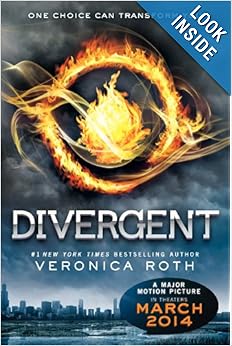
Divergent by Veronica Roth


‘There’s a difference between not being afraid and acting in spite of fear,’ Divergent, Ch12

Divergent by Veronica Roth is the first book of a trilogy. It is about a world where it is split into five factions: Erudite, Dauntless, Abnegation, Amity and Candor. Each year, 16 year olds have to choose only one of them to live in for the rest of their lives. Beatrice, one of these 16 year olds, struggles to make her decision, she can’t choose between family and where she feels like she truly belongs. In a world that’s supposed to be perfect, Beatrice sees the real truth. That nothing can stay perfect for long.

Divergent is a very well known book so that’s why I decided to read it. I was a little bit disappointed in the beginning of the book, because it didn’t capture my interest like I thought it would. There have been many positive comments on the book, so my expectations were very high.  The book didn’t get my interest right from the start, but after a few chapters it was definitely a page-turner.