Pages

Showing posts with label science fiction. Show all posts

Monday, 27 November 2017

Fahrenheit 451 by Ray Bradbury


“The magic is only in what books say, how they stitched the patches of the universe together into one garment for us.” 

Fahrenheit 451 is a science fiction dystopian story about a world that has banned books. The world has become increasingly superficial. People are discouraged to think and ask questions. Television shows stimulate the senses and body rather than the brain. The protagonist is a firefighter, someone who burns books for a living. In the beginning, he is content in his life. But as he meets a very curious and unique seventeen-year-old girl, he begins to critically analyse. Through the course of the story, he starts to understand the importance of books in passing knowledge, philosophy and presenting to us both the good and bad in life, society and us.

Bradbury’s work for me was more of a poetic essay. A very short read, a very linear and simple plot but one that is heavily based on philosophy. A complete contrast to the world it presents in the book.  It shows that content ignorance, a world with no controversies, doesn’t lead to a happy life. As we see through the suicidal tendencies of Guy’s wife. Human relationships are also much more superficial, as people became shallower. So, while I agree with a more egalitarian society we cannot let political correctness and fear of offending, stop us from being critical or placing self/society imposed censoring on controversial pieces of work.  

I am personally a part of this problem...

Friday, 6 November 2015

iBoy by Kevin Brooks

“we’re all … animals - none of us know any better”

iBoy by Kevin Brooks is the story of a teenage boy who acquires ‘superpowers’. When someone throws an iPhone from the top of a 30 story building, Harvey’s head is cracked and the iPhone pieces get stuck inside his brain. Harvey is able to everything that a phone can do and much more. He seeks revenge on the gang members who hurt his childhood friend, Lucy. He becomes known as iBoy, a superhero protecting the violent local area. But in all of that, Harvey loses himself to iBoy as the line between good and bad starts to blur.

After reading How to be Invisible, I simply assumed that this would be another book for pre-teens. However, this book contains some heavy themes and should be read by younger adolescents. (Maybe 15 and up? It really just depends on maturity…)

Monday, 22 September 2014

Brave New World by Aldous Huxley

“One believes things because one has been conditioned to believe them.”

Brave New World by Aldous Huxley reminds me of a more disturbing and extreme version of 1984. The 20th Century novel is set in London in 2540 (in the book, known as 632 after Ford).  The world is stable; nobody ever suffers, the world is united, the people are happy and everyone is in a job that is satisfactory to them. However, this means controlling everything; the world has a stable population of 2 billion, children are ‘manufactured’ in labs, genetically modified to fit a caste and then educated – almost traumatized/terrorized – to fit into society. The lower castes (the majority of the population) are bred through a process in which one single egg produces up to 96 identical children. When Bernard and Lenina travel to the “Savage Reservation”, they are shocked at the difference between the two worlds. They end up encountering, John, a young man that was born from World State parents but born and raised in the Savage World. John is an outsider due to his appearance in the primitive village, and finds comfort in reading Shakespeare. Bernard decides to take John and his mother back to London. However, John finds the ‘civilized’ society appalling and is still feels as the outsider...

Sunday, 20 April 2014

1984 by George Orwell


“Perhaps one did not want to be loved so much as to be understood.” 


1984 by George Orwell is a science fiction story that attacks totalitarianism. The book is set in the superstate of Oceania, in the province called Airstrip One. Everything and everyone from the party is monitored all the time by Big Brother, the supreme leader. Anyone who shows any sign of rebelling against IngSoc (the government) is punished, tortured until they confess to all sorts of crimes and then killed. Winston, the protagonist, works in the Ministry of Truth. His jobs are to falsify records. Smith inwardly rebels and finds that there are others like him. However, the Party can see everything and so Winston is not as successful as he thinks and is ultimately betrayed by his co-worker in the end.

Should you read this book? Definitely! Not only is this book a classic and references to it all the time in media, pop culture and everyday life but it is surprisingly entertaining and easy to read. From the beginning, I understood everything and I was actually invested in the story, I say ‘actually’ because the classic novels are not always so accessible to modern teen readers and this was an exception. Although, I have to warn any future readers, that the ending is not a happy one and while this was necessary to prove Orwell’s point, I am never one to be satisfied with a sad ending.

George Orwell uses the novel to warn the readers of that time about communism and totalitarianism in general. George Orwell sets the story in 1984 - only 35 years after the publication date – so to warn the English public that this could easily happen to them if they didn’t ward off totalitarianism. The Cold War at that time had not escalated yet and so there were still some academic supporters. As Orwell put it, “Every line of serious work that I have written since 1936 has been written directly or indirectly against totalitarianism and for Democratic Socialism as I understand it." Orwell was against the communist up rise in Russia and Spain and so sought to warn the British and Americans of this. Personally, I agree with Ben Pimlott’s introduction (Penguin publication) which stated that this book was also an attack on the direction of the British Labour government, at that time, into state socialism. Orwell may have been a democratic socialist but I don’t think he was pleased with the direction the Labour government was heading in. Mostly, because the name of the government in 1984 was IngSoc, meaning English Socialism in Newspeak. This meant that England/Britain was still the power house of Oceania; it wasn’t another country such as a Russia who had taken over England and turned it communist. [NOTE: Going back now, I really think George Orwell wrote about Totalitarian Russia. As I am studying Russia in Stalin's period, I see more and more similarities about the past Russia and 1984 - it is really shocking. Things like the no persons, trials for people who used to be part of the party and even thought crime occurred in Russia.] 

Friday, 28 February 2014

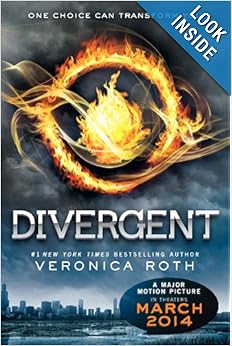
Divergent by Veronica Roth


‘There’s a difference between not being afraid and acting in spite of fear,’ Divergent, Ch12

Divergent by Veronica Roth is the first book of a trilogy. It is about a world where it is split into five factions: Erudite, Dauntless, Abnegation, Amity and Candor. Each year, 16 year olds have to choose only one of them to live in for the rest of their lives. Beatrice, one of these 16 year olds, struggles to make her decision, she can’t choose between family and where she feels like she truly belongs. In a world that’s supposed to be perfect, Beatrice sees the real truth. That nothing can stay perfect for long.

Divergent is a very well known book so that’s why I decided to read it. I was a little bit disappointed in the beginning of the book, because it didn’t capture my interest like I thought it would. There have been many positive comments on the book, so my expectations were very high.  The book didn’t get my interest right from the start, but after a few chapters it was definitely a page-turner.

Saturday, 6 April 2013

Frankenstein by Mary Shelley


“Beware; for I am fearless, and therefore powerful.”  - From the novel, Frankenstein


Frankenstein by Mary Shelley is Gothic genre book written in the 1818. Victor Frankenstein is an university student whose ambitions and passion for the science leads him to create something no one has ever deemed possible, he created life using dead humans' body parts. However, as soon as he finishes his project he realises the mistake.To him, the monster is vile and gruesome. The story is told through the letters of Captain Robert Walton, who found Frankenstein nearly at a state of emaciation. His letter not only incorporates Victor's story telling but Victor's own letter and even the monster's side of the story as he tells it to Victor who then tells it to Walton. 

How do I begin..

The novel was completely different to what I imagined and it gets me so frustrated that the movies are so different to the book. I don't think Mary Shelley would have been too happy with the movies made of Frankenstein  not only because they are so different but because they lose the themes and morals. There are various movies that came out on Frankenstein but most of them have the Creature as some sort of complete monster who can't talk at all other than grunts. In the book Frankenstein was so eloquent and always gave an explanation as to why he became the way he was. In one of the movies the Monster was bad tempered was because the brain used was a criminal's brain, however in the book the Monster killed people because of the injustice that he suffered because of his appearance. Also, they even changed the name of Victor Frankenstein to Henry and made the character lose the feeling of isolation. In one of the movies there are sequels (eg. Frankenstein's Bride) but in the book Frankenstein died... I mean, I know movies are usually a bit different to books so that it flows more and scenes are changed so that emotions and reasoning are depicted visually rather than worded out but this is just ridiculous.  

Monday, 11 February 2013

The Giver by Lois Lowry


" The worst part of holding the memories is not the pain. It's the loneliness of it. Memories need to be shared.” – The Giver

Jonas was born into a perfect society. Every little detail was organised and planned, everything was methodical and conventional. No one ever experienced thirst, hunger or pain – no one even knew these things could exist. By the time children reach 12 they are told what they will work as; even though they didn’t have the freedom to choose what area they would work, their job was a perfect reflection of their personalities. Jonas was given the most honourable job as the “Receiver”. He will be in charge of all the memories, therefore no one else has to experience pain but there is one person to remember and not repeat mistakes in history. However, when Jonas starts receiving memories he opens his eyes to a whole other world. No one feels pain but nor do they feel love, everything is the same for everyone but there is no colour – the world is grey - there is no sunshine or soft snow. Jonas realises holding memories may be painful but they hold so much warmth and happiness that everyone should have the opportunity to experience them and most importantly have a choice in life.

The Giver by Lois Lowry is a science fiction book reflecting on the perfect world and the importance of memories, experiences and free choice. Lowry wrote the book after her father lost most of his long term memory. Memories can traumatise someone but they are so important to learn from and to grow from. Memories also contain just as much, if not even more, goodness in them.

Lois Lowry tries to create the perfect world, but the whole concept of perfectness can never be truly established within the limitations of human’s imaginations. It is only subjective to one’s perceptions. Therefore when the characters in the book went through their lives they didn’t question it.

Monday, 8 October 2012

Eve (the Eve Trilogy) by Anna Carey

“A relationship between two people can be judged by the list of things unspoken between them.”  - Eve

Eve by Anna Carey is the first in the Eve Trilogy. The story is set in 2032, in the New America after a plague (and its vaccine that was meant to help) killed most of the world's population. The U.S.A is now ruled by a King. Girls and boys are completely separated into schools. Eve, the protagonist, is graduating from school and hopes to become a great painter. One day before graduation one of her colleagues shares her plans and knowledge with Eve. It seems that the King nor the teachers are telling the truth. Everything she believed in is a lie. Eve escapes all of this and meets Caleb. They fall in love but with them being fugitives she must choose between safety and love. 

This book is AMAZING!! I don't really know exactly where this books achieves this success or how Anna Carey did it but I just found I was completely absorbed by the book and the characters. I read non stop and finished it in less than a day. I would burst out at random moments screaming for Eve or Caleb, I was nearly crying at the end when Caleb was leaving. This is seriously such a cute, sweet book for all the dreamers and thinkers out there.