Pages

Showing posts with label school. Show all posts

Wednesday, 4 November 2015

How to be Invisible by Tim Lott


“Trust is invisible too, but it turns out that that it’s the invisible things that matter most of all”


How to be Invisible by Tim Lott is the story of a 13 year old science genius who, as per the title, learns how to turn invisible. Strato Nyman, just moved schools and was having a hard time fitting in. When he discovers how to be invisible, he finds out that no one is ever really ‘visible’. He learns a lot about his family, his friends, his bullies and even his teacher.  

I think I may be too old for this book. I kind of worked that out from the age of the protagonist. However, the title seemed so interesting, I decided to read it anyway. So, of course since I’m not the target audience, this review might be a bit harsh.

Wednesday, 1 April 2015

Stasiland by Anna Funder

“Though it is the hardest thing, to work out one's weight and heft in the world, to whittle down all that I am and give it a value.” - Anna Funder
Stasiland is Australian Anna Funder’s literary journalism of Germany’s dark past.  In 1996, seven years after the reunification of Germany, Funder is working in television in West Berlin and grows interested in the occupants of the former German Democratic Republic. She explores the stories of the victims and perpetrators of the Stasi in East Germany. Anecdotes are drawn from people who answer to Funder’s newspaper advertisements and Funder’s own acquaintances. Miriam is the ‘tragic hero’ of the text. Funder sympathises with the 16-year-old who came to be considered an enemy of the state. Miriam tells the story of Charlie, her husband that was killed in custody. Miriam’s story is interwoven with the stories of Julia and Frau Paul. Julia is Funder’s land lady, although reluctant about telling her story, shares the details of how her family went through “internal emigration”. Julia was ostracized because of her Italian boyfriend even though she had no intentions to go against the state. Frau Paul shares her story of how her sick baby was taken to West Berlin for treatment and because of her attempts to visit her son she becomes embroiled with a group helping people leave East Berlin. These sad stories are mixed with the stories of the perpetrators, the people who worked with or helped the Nazi, including Herr Winz, Hagen Koch, Karl E. Schnitzler and Herr Bock. Many of these men think back to the GDR with nostalgia and little to none remorse. Funder’s story is a personal and passionate exploration of Germany’s Stasi epoch.

I really enjoyed Stasiland, and I don’t often read non-fiction. Funder’s literary journalism style may not be conventional or the most factual but I found that it is creates a very interesting way to read non-fiction. I could empathise with these real life characters and it added a breath of fresh air into a topic that is now often seen only through the details of school textbooks.

Friday, 2 January 2015

Hiroshima by John Hersey

"What has kept the world safe from the bomb since 1945 has not been deterrence, in the sense of fear of specific weapons, so much as it's been memory. The memory of what happened at Hiroshima." - John Hersey

Hiroshima by John Hersey is simply summarized as the story of the atomic bomb survivors. Hiroshima follows the story of six of the survivors and the impact of the bomb on their lives. Hersey uses a style of New Journalism - using fiction writing techniques to recount true stories. This allows for readers to really understand the horrific consequences of war and of the nuclear bomb; while the book is non-fiction it focuses on the stories of ordinary people instead of data and statistic.

There is not much to add to this review, it is simply a truly poignant account of ordinary people affected by the decisions of power hungry governments. The book is a fantastic way to gather information on the context and impacts of the bomb. Hiroshima is sad and it's tragic, but it's real life. I (hopefully) will never understand the full effect of the bomb, but this book was able to open my previously ignorant eyes. I had always thought of the atomic bomb as being a completely horrible and unnecessary weapon, but it wasn't until I connected with the characters Hiroshima and saw their struggles that I realized the meaning that horrible and tragic can really take. I knew the facts on what the bomb is capable of, of the number of casualties, their mutations, the amount of town and buildings ruined, but no teacher had been able to pass on the impact of the bomb as clearly and as moving.

Thursday, 1 January 2015

An Artist of the Floating World by Kazuo Ishiguro

“A man who aspires to rise above the mediocre, to be something more than the ordinary, surely deserves admiration, even if he fails and loses a fortune on account of his ambitions . . . if one has failed only where others have not had the courage or will to try . . .  to be gained from his observation when looking back over one's life."

Kazuo Ishiguro's An Artist of the Floating World, follows the story of Masuji Ono, a propagandist artist for Japan Imperialism during the war. Following Japan’s defeat in the war, Ono becomes a discredited figure; his daughter, evermore influenced by her husband, criticizes her father for his past. To make it worst, Ono’s wife and son were killed and his youngest daughter was in her mid 20s and having trouble finding a husband. Ishiguro manages to provide a peek into post-war Japan and how the paradigms were shifting. The old tradition and ideas had to adapt to the new way of life, one that closely followed the USA. Ono is caught between worlds; he is ‘an artist of the floating world’.

This story is short, flowing and presents an interesting view, there is no reason why anybody shouldn't take a few hours (or less) to read Ishiguro’s, ‘An Artist of the Floating World’. The whole story is told in Ono’s point of view, I found this quite different as many novels don’t place an old retired man as the protagonist of the book. However, I found this technique captured perfectly the hypocritical state and the imbalanced state that Japan was left during the war. Ono had been considered a very patriotic Japanese. Now, he still had pride, he did what he believed was right and he was a well-known artists, however, he being forced to change his views and his whole history in order to be a ‘loyal’ Japanese. Ono’s mind quite often strayed and spoke about different ideas, but I think that he was, inherent to Japanese culture, very structured and the novel never became a stream of consciousness. At times, I did get lost as there were so many names and so many really similar names – I found it more confusing when Ono’s story would stray for five pages and he would suddenly remind himself to get back to the story. However, this way we are taken into the mind of the retired man, he has a lot of time to reminisce and he lives in a very tranquil state of mind even with everything going around him.

Friday, 12 September 2014

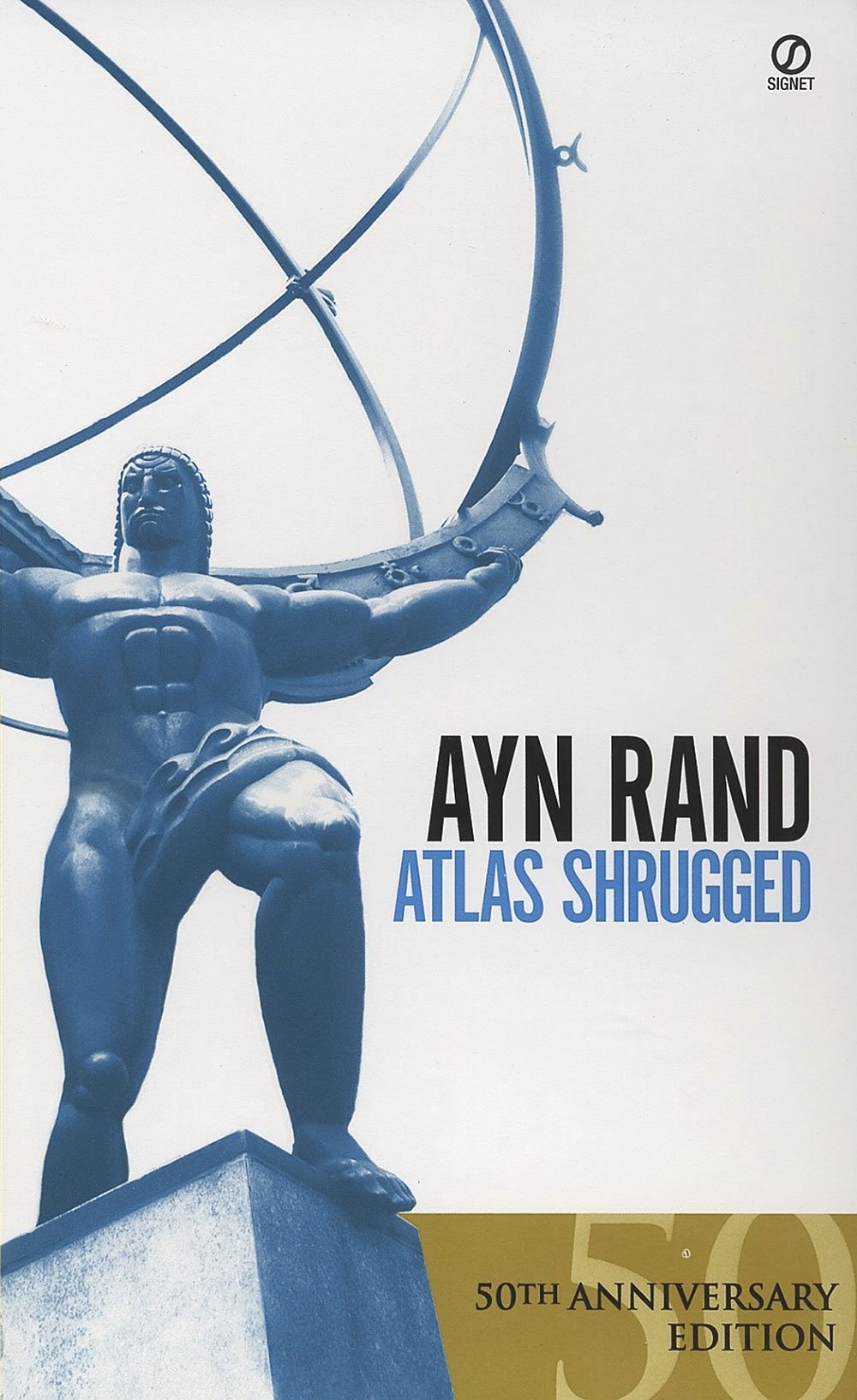
Atlas Shrugged by Ayn Rand

“I started my life with a single absolute: that the world was mine to shape in the image of my highest values and never to be given up to a lesser standard, no matter how long or hard the struggle.” 

“If you don't know, the thing to do is not to get scared, but to learn.” 

“It is not death that we wish to avoid, but life that we wish to live.” 

Atlas Shrugged by Ayn Rand is the story of the creative minds, the hard workers, the inventors protesting against the corrupt government and society. It is mostly told through Dagny Taggart’s (a railroad executive) point of view. She struggles to follow her moral code and love for her industry while having to sacrifice everything for a society/government that judges her as amoral; taking advantage of her virtues. John Galt becomes the symbol of everything she hates, but mostly everything she loves. Dagny finds a broken down motor which runs on static electricity, as she tries to find the inventor and his reasons for abandoning the motor she begins to find a whole new world and philosophy. Dagny is reluctant to give up her railroad but she begins to see that she is only helping the looters.

As you should be able to tell by my use of three quotes, I really liked the book and what it had to say. I had previously read, We the Living, and I had really enjoyed it so I decided to read another of Rand’s book. I must say, I have found that I really agree with Rand’s philosophy. There were a lot of teachers that did not support me reading this book, they thought it would ‘brainwash’ me; too extremist. I don’t think these teachers had completely read the book, because too me it wasn't just about being rich and selfish. Sure, it justified capitalism and some things were exaggerated; however, it talked about hard work, about only giving and taking what is deserved and about money being important but only the tool and not the means or the end.

Friday, 19 April 2013

Persuasion by Jane Austen


“How quick come the reasons for approving what we like.”  - Jane Austen,


Persuasion by Jane Austen is the story of Anne Elliot; a witty, independent and intelligent woman of the upper class in the 19th Century. Eight years before the start of the novel, Anne was still a young woman when she fell in love with Officer Frederick Wentworth. However, she was persuaded against this love. Now, in the present she is already 27 and much wiser. She meets again with now, Captain Frederick. This is not only their love story but also the satire of society’s vanity and social class.

At the start I found the book quite hard, I thought that I would actually be writing this review differently and saying that I didn't think this was a book for my level and age, mid-teens. The words were quite hard, like any other classic and the names sometimes got me confused, especially the two Charles and it didn't help they were cousins. However, once the story started taking shape the whole thing became easier to read and follow. 

I quite enjoyed this book, but I do have one comment that to me seems to correlate with Jane Austen’s literary work; I find that Austen writes books that if they were written nowadays they would have been considered ‘teen fiction’ with a bit of romance. It may be because I am used to the thrill of fantasy novels but I found that Persuasion didn’t have a very strong plot. As I said, I enjoyed reading the novel however, as I go over the story I don’t know how the story took over so many pages. It was basically the day to day life of Anne Elliot and her seeing Captain Wentworth again. There were little complications, like there would be in real life but nothing major. I read in the trusty J sparknotes that the climax was when Wentworth gave Anne the letter announcing that he still loved her.  However, this scene was one of the last in the books, were all the other 150 or 200 pages just the introduction and a very small build-up?

Saturday, 6 April 2013

Frankenstein by Mary Shelley


“Beware; for I am fearless, and therefore powerful.”  - From the novel, Frankenstein


Frankenstein by Mary Shelley is Gothic genre book written in the 1818. Victor Frankenstein is an university student whose ambitions and passion for the science leads him to create something no one has ever deemed possible, he created life using dead humans' body parts. However, as soon as he finishes his project he realises the mistake.To him, the monster is vile and gruesome. The story is told through the letters of Captain Robert Walton, who found Frankenstein nearly at a state of emaciation. His letter not only incorporates Victor's story telling but Victor's own letter and even the monster's side of the story as he tells it to Victor who then tells it to Walton. 

How do I begin..

The novel was completely different to what I imagined and it gets me so frustrated that the movies are so different to the book. I don't think Mary Shelley would have been too happy with the movies made of Frankenstein  not only because they are so different but because they lose the themes and morals. There are various movies that came out on Frankenstein but most of them have the Creature as some sort of complete monster who can't talk at all other than grunts. In the book Frankenstein was so eloquent and always gave an explanation as to why he became the way he was. In one of the movies the Monster was bad tempered was because the brain used was a criminal's brain, however in the book the Monster killed people because of the injustice that he suffered because of his appearance. Also, they even changed the name of Victor Frankenstein to Henry and made the character lose the feeling of isolation. In one of the movies there are sequels (eg. Frankenstein's Bride) but in the book Frankenstein died... I mean, I know movies are usually a bit different to books so that it flows more and scenes are changed so that emotions and reasoning are depicted visually rather than worded out but this is just ridiculous.  

Sunday, 31 March 2013

Diving for Pearls by Katherine Thomson


Diving for Pearls by Katherine Thomson is the story of working class Australians in the changing world of the 1980s to 90s. It is set in an industrial (most probably Wollongong) town, where the industries are now being sold to create a resort. The main characters are Barbara, her lover Den, Barbara's daughter Verge and Barbara's brother in law Ron. 

I am not sure if Diving for Pearls fits into the book review categories but I read the play as if it was a book so I am writing about it. Actually, this is more me complaining and whining about the play. I had to read it for school and I didn't even understand hot it can pass as an actual play. 

The play is supposedly trying to show what it was like for Australians in the late 80s and early 90s, especially for those in the steel industries. If the book was successful in doing so, then Australians were really rude, pessimistic and unmotivated or just plain unskilled. It was ridiculous how many swear words were in the play, while I understand that Thomson was trying to show the real day to day life (very generalised) of the working class Australia of that time period, it didn't make the play any less inappropriate for a class reading as well as making Australians seem really bad. 

The worst part of the play was that I couldn't empathise with the characters. I couldn't understand their personalities and motives and so the story was never real to me. A good book or play is supposed to make you feel for the characters and understand them so that their story becomes real. This play was the complete opposite