Pages

Showing posts with label analysis. Show all posts

Monday, 27 November 2017

Fahrenheit 451 by Ray Bradbury


“The magic is only in what books say, how they stitched the patches of the universe together into one garment for us.” 

Fahrenheit 451 is a science fiction dystopian story about a world that has banned books. The world has become increasingly superficial. People are discouraged to think and ask questions. Television shows stimulate the senses and body rather than the brain. The protagonist is a firefighter, someone who burns books for a living. In the beginning, he is content in his life. But as he meets a very curious and unique seventeen-year-old girl, he begins to critically analyse. Through the course of the story, he starts to understand the importance of books in passing knowledge, philosophy and presenting to us both the good and bad in life, society and us.

Bradbury’s work for me was more of a poetic essay. A very short read, a very linear and simple plot but one that is heavily based on philosophy. A complete contrast to the world it presents in the book.  It shows that content ignorance, a world with no controversies, doesn’t lead to a happy life. As we see through the suicidal tendencies of Guy’s wife. Human relationships are also much more superficial, as people became shallower. So, while I agree with a more egalitarian society we cannot let political correctness and fear of offending, stop us from being critical or placing self/society imposed censoring on controversial pieces of work.  

I am personally a part of this problem...

Thursday, 2 April 2015

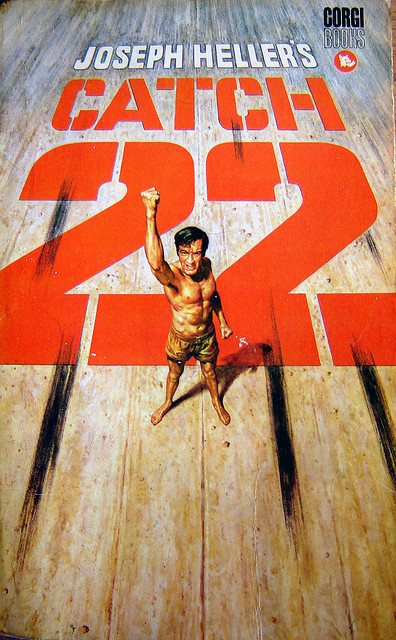
Catch-22 by Joseph Heller

“...[A]nything worth dying for ... is certainly worth living for.” 


Catch-22 by Joseph Heller is set during WWII on island of Pianosa (though the setting is of little importance). It follows the story of a common soldier, Yossarian, and his friends. Yossarian has lost many of his colleagues and friends to the war. His problems are further perpetuated by Colonel Cathcar, who keeps raising the number of missions the men had to fly to complete their service. No matter, how much Yossarian longs to be sent home, he is trapped by a ‘Catch-22’. The term, coined by Heller, refers to the paradoxical set of circumstances that the characters are often faced with; especially, the idea that any soldier who is willing to fly is insane and could be sent home if he asked for it, however, as soon as he asks to be sent home he shows concern for his safety and is therefore of a rational mind.

Heller’s satirical book is, despite initial controversy, a defining novel of the 20th Century. Despite it being set during WWII, the book concerns postmodernist ideas. The book is still taught in schools and contains important critiques that can still be applied to modern society. Any reader has to be prepared to face the absurdity of Heller’s work. Personally, I did not enjoy the book. However, this is because I prefer the structure and predictability of Victorian literature. But I am glad that I read this book. I thought Heller presented very important ideas and I agreed with many of his values; some of these ideas will be explored later in this review.

The novel has become representative of postmodernist literature by its subversion of form to represent the zeitgeist of the time. The book uses an ‘anti-novel’ structure and an ‘anti-hero’. The book rejects many of the traditional novel formats. The book is not written in chronological order and does not follow the structure of introduction, climax and conclusion. Instead the reader is introduced to Yossarian in a hospital talking about events that will only occur at the end of the book. Yossarian talks about the death of Snowden during a mission that isn’t described until the second last chapter of the book. The novel also has an ambiguous ending, living questions unanswered. Yossarian, the protagonist, is not a ‘hero’. Yossarian has many faults and is quite insane – or at actually he is quite sane in an insane world. Yossarian does not have the courage and intengrity that heroes often display. The whole plot follows Yossarian’s plan to escape, including the lies he creates to stay in a hospital where he can escape his duties. These are two of the main ways that Heller changes the format of books in order to represent the new values of the postmodern world.

Themes

Wednesday, 1 April 2015

Stasiland by Anna Funder

“Though it is the hardest thing, to work out one's weight and heft in the world, to whittle down all that I am and give it a value.” - Anna Funder
Stasiland is Australian Anna Funder’s literary journalism of Germany’s dark past.  In 1996, seven years after the reunification of Germany, Funder is working in television in West Berlin and grows interested in the occupants of the former German Democratic Republic. She explores the stories of the victims and perpetrators of the Stasi in East Germany. Anecdotes are drawn from people who answer to Funder’s newspaper advertisements and Funder’s own acquaintances. Miriam is the ‘tragic hero’ of the text. Funder sympathises with the 16-year-old who came to be considered an enemy of the state. Miriam tells the story of Charlie, her husband that was killed in custody. Miriam’s story is interwoven with the stories of Julia and Frau Paul. Julia is Funder’s land lady, although reluctant about telling her story, shares the details of how her family went through “internal emigration”. Julia was ostracized because of her Italian boyfriend even though she had no intentions to go against the state. Frau Paul shares her story of how her sick baby was taken to West Berlin for treatment and because of her attempts to visit her son she becomes embroiled with a group helping people leave East Berlin. These sad stories are mixed with the stories of the perpetrators, the people who worked with or helped the Nazi, including Herr Winz, Hagen Koch, Karl E. Schnitzler and Herr Bock. Many of these men think back to the GDR with nostalgia and little to none remorse. Funder’s story is a personal and passionate exploration of Germany’s Stasi epoch.

I really enjoyed Stasiland, and I don’t often read non-fiction. Funder’s literary journalism style may not be conventional or the most factual but I found that it is creates a very interesting way to read non-fiction. I could empathise with these real life characters and it added a breath of fresh air into a topic that is now often seen only through the details of school textbooks.

Sunday, 20 April 2014

1984 by George Orwell


“Perhaps one did not want to be loved so much as to be understood.” 


1984 by George Orwell is a science fiction story that attacks totalitarianism. The book is set in the superstate of Oceania, in the province called Airstrip One. Everything and everyone from the party is monitored all the time by Big Brother, the supreme leader. Anyone who shows any sign of rebelling against IngSoc (the government) is punished, tortured until they confess to all sorts of crimes and then killed. Winston, the protagonist, works in the Ministry of Truth. His jobs are to falsify records. Smith inwardly rebels and finds that there are others like him. However, the Party can see everything and so Winston is not as successful as he thinks and is ultimately betrayed by his co-worker in the end.

Should you read this book? Definitely! Not only is this book a classic and references to it all the time in media, pop culture and everyday life but it is surprisingly entertaining and easy to read. From the beginning, I understood everything and I was actually invested in the story, I say ‘actually’ because the classic novels are not always so accessible to modern teen readers and this was an exception. Although, I have to warn any future readers, that the ending is not a happy one and while this was necessary to prove Orwell’s point, I am never one to be satisfied with a sad ending.

George Orwell uses the novel to warn the readers of that time about communism and totalitarianism in general. George Orwell sets the story in 1984 - only 35 years after the publication date – so to warn the English public that this could easily happen to them if they didn’t ward off totalitarianism. The Cold War at that time had not escalated yet and so there were still some academic supporters. As Orwell put it, “Every line of serious work that I have written since 1936 has been written directly or indirectly against totalitarianism and for Democratic Socialism as I understand it." Orwell was against the communist up rise in Russia and Spain and so sought to warn the British and Americans of this. Personally, I agree with Ben Pimlott’s introduction (Penguin publication) which stated that this book was also an attack on the direction of the British Labour government, at that time, into state socialism. Orwell may have been a democratic socialist but I don’t think he was pleased with the direction the Labour government was heading in. Mostly, because the name of the government in 1984 was IngSoc, meaning English Socialism in Newspeak. This meant that England/Britain was still the power house of Oceania; it wasn’t another country such as a Russia who had taken over England and turned it communist. [NOTE: Going back now, I really think George Orwell wrote about Totalitarian Russia. As I am studying Russia in Stalin's period, I see more and more similarities about the past Russia and 1984 - it is really shocking. Things like the no persons, trials for people who used to be part of the party and even thought crime occurred in Russia.] 

Sunday, 16 March 2014

To the Lighthouse by Virginia Woolf

“He smiled the most exquisite smile, veiled by memory, tinged by dreams.” 

To the Lighthouse by Virginia Woolf is one of the most well known modernist books. The novel was written in a stream-of-consciousness style and it was set in three parts and the plot can be really quickly summed up with:


The Window: Mrs. and Mr. Ramsay with their children and guests spending time in their Scottish holiday home. Six-year-old James wants to go the lighthouse, his mother agrees but Mr. Ramsay states that the weather is not good enough for the boat journey. One of the guests, Lily Briscoe is painting. Paul Rayley and Minta Doyle (two guests) get engaged.
Time Passes: World War 1 breaks out and the house is left abandoned. Everyone dies... Jokes – it just felt like that. Mrs. Ramsay died suddenly, Andrew Ramsay (oldest son) dies in battle and Prue (daughter) dies after giving birth. (Note: the deaths are all told in brackets)
The Lighthouse: Mr. Ramsay with his children (those that are still alive) and two of his guests decide to go back to the house. Mr. Ramsay makes his children go with him to the Lighthouse. Lily goes back to painting and this time manages to achieve her vision.

Personally, the summary that I just gave was exactly what a whole 227 page novel spent describing. But, if you’ve read my review on Mrs. Dalloway, my lack of enthusiasm for Virginia Woolf wouldn’t be surprising. For me, I need a plot that I can invest myself in. However, one thing that I must give to Woolf is her sense of rhythm, like the repetitive and familiar lives of the Ramsays as the waves come and go in their island. Only when I went back to the introduction written by Hermione Lee in 1991 (it was included in the version I borrowed) that I realised how much of a difference her editing and style really made. Read the manuscript version to see for yourself:

Friday, 28 February 2014

Mrs. Dalloway by Virginia Woolf


"This late age of the world's experience had bred in them all, all men and women, a well of tears" 


Mrs. Dalloway by Virginia Woolf is written in a stream-of-consciousness form; as were many modernist literature. The story is set in only one day, as Clarissa Dalloway organizes a party. The story reveals her thoughts and ideas. It also explores the interwoven stories of Dalloway's friends and husband. The story is told in parallel with a War Veteran suffering from post traumatic stress disorder. Even though the veteran is quite disillusioned he shares Clarissa's feeling of oppression by society. 

Personally, I did not enjoy this book as much as I had hoped to. This is due to my own dislike of the usual modernist style. I much prefer structure and a full narrative. However, I do enjoy analyzing and breaking apart this style of story. The more you analyse the more little 'tricks' and ideas of life and society that were so subtly criticized/analysed are discovered.

Saturday, 25 January 2014

Paladin by Dave Luckett

“Good if they were good, but they weren't always good... Power goes to most people’s head, you know.” (p. 27)

Paladin by Dave Luckett is the exploration of truth and justice by placing the protagonists into fantasy second dimension/world. Sam and Finny live as outcasts in their city, until they find out that they belong to another world. Both Sam and Finny have magical talents that are needed in to fight evil in another land.

Firstly, the novel was a pleasant short read but it wasn't a great book. Paladin isn't bad but it isn't very good either, it’s just mediocre. While, I enjoyed the hour or two it took me to read I wouldn't recommend this book, simply because there are other fantasy novels that are better. The main reasons for this were that it was very brief and unoriginal. However, there were some nice themes investigated.

Thursday, 17 October 2013

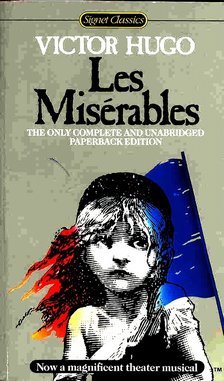
Les Misérables by Victor Hugo


“If the soul is left in darkness, sins will be committed. The guilty one is not he who commits the sin, but the one who causes the darkness. " - [Monseigneur Bienvenue] Les Misérables.


Les Misérables by Victor Hugo is the story, set in the 19th Century, of the intertwining lives of Jean Valjean, Fantine, The Theodores, Javert, Cosette and Marius Pontmercy. Jean Valjean was a convict, released after 19 years in prison. He goes from a distraught, dark and even malicious man to a "saint". He grows to become very successful and a respected man in his new town. That is, until Javert (a police agent) discovers the truth and Jean Valjean must escape. The others are characters that he meets later on that affect his actions and attitudes. 

This book was amazing!!! Don't get me wrong,I struggled a lot at the start and it took me months to read the book, but it was all worth it! Because the stories all intertwine at the end, it is only at the end of each chapter and especially at the end of the book that the story seems to be making complete sense and it is at such moments that the book becomes so gripping. Victor Hugo did a fantastic job exploring the darkest parts of society and while it seemed dry at some parts, it all joined up to create a very well written and intriguing book. It is one of those times that you have to step away to see the whole picture. I have to admit, the language was quite hard at times and I did not understand everything and I'm sure I missed important ideas Hugo wrote. I will definitely revisit this book in a few years to get even more from it...