Pages

Showing posts with label ideas. Show all posts

Saturday, 14 November 2015

The Fountainhead by Ayn Rand

“To sell your soul is the easiest thing in the world. That's what everybody does every hour of his life. If I asked you to keep your soul - would you understand why that's much harder?” 
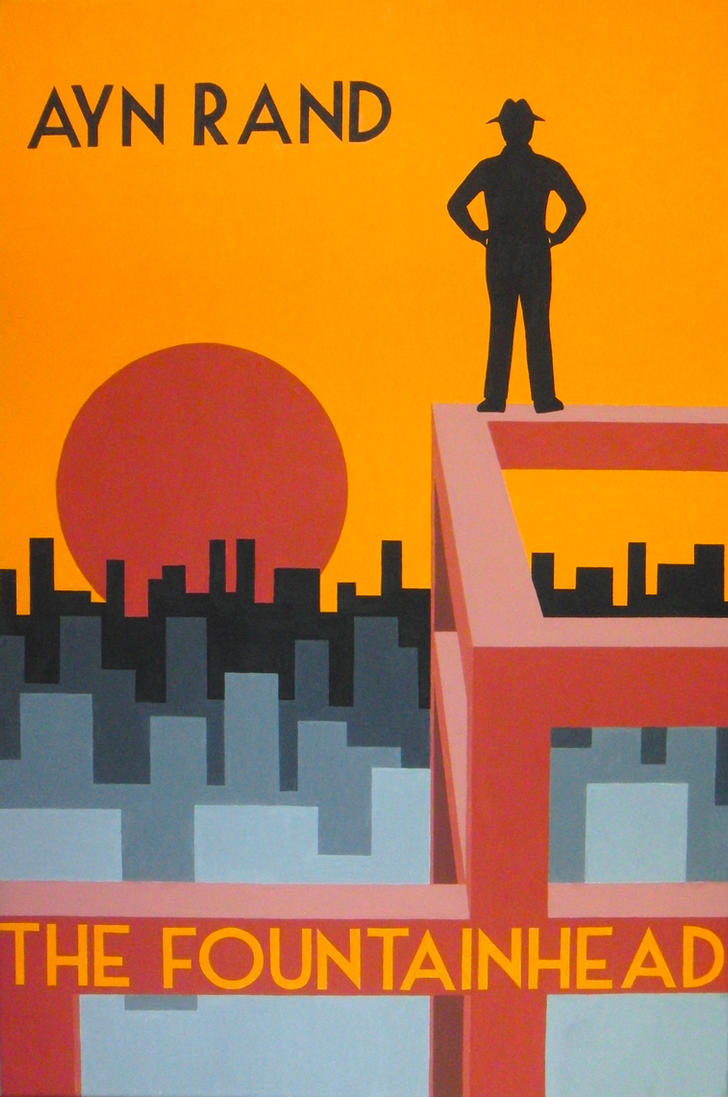
The Fountainhead by Ayn Rand is about architect, Howard Roark, working against the tides of society. He knows what he wants, and has a need to design. However, his designs are his own and are not accepted by a society of ‘second-handers’. His genius and independence are threats to the way society is functioning. His rivals, those who seek power, control and self-sacrifice from the common people, will stop at nothing to bring him down. There are only a few people who are Roark’s equal. But even Dominique Francon has much to learn about Roark’s philosophy.

It is strange that Rand’s novels have a way of making me like them at the end, no matter how much I hated it in the middle. I found The Fountainhead, much easier to read than Atlas Shrugged. But despite this, there were moments that I thought the story was heading down hill. I struggled to understand some of her ideas, especially that of love. I thought that the scene were Roark goes into Dominique’s bedroom and ‘claims’ her, was completely unnecessary (well, actually, maybe not unnecessary but in my point of view it went a bit too far.) The reason I liked this book was combination of factors – I liked it because of a sense of accomplishment when I got to the end of such a heavy and long book, because I agreed with the ideals she presented (even if some of them appeared as caricatures) and most of all, I like Rand’s books because she somehow manages to leave a sense of hope and resolution even though there is never exactly a ‘happy ending’.

I know that many people regard Rand’s writing as a ‘cult’. I don’t. I like reading her novels, and I don’t every think I have to hide them. I like her ideas; I like the idea of independent thinking. The problem is that I know that no matter how much I try, whatever I think will just be a copy of what someone else had thought before, and I can assume that much. What I do try to achieve, is to read, watch and listen to as many opinions and thoughts as possible, I can then try to decide which mix of ideas makes the most sense to me. By then saying ‘yes’ to these ideas, they can become ‘mine’, independent of who created the thoughts/values.

Friday, 6 November 2015

iBoy by Kevin Brooks

“we’re all … animals - none of us know any better”

iBoy by Kevin Brooks is the story of a teenage boy who acquires ‘superpowers’. When someone throws an iPhone from the top of a 30 story building, Harvey’s head is cracked and the iPhone pieces get stuck inside his brain. Harvey is able to everything that a phone can do and much more. He seeks revenge on the gang members who hurt his childhood friend, Lucy. He becomes known as iBoy, a superhero protecting the violent local area. But in all of that, Harvey loses himself to iBoy as the line between good and bad starts to blur.

After reading How to be Invisible, I simply assumed that this would be another book for pre-teens. However, this book contains some heavy themes and should be read by younger adolescents. (Maybe 15 and up? It really just depends on maturity…)

Thursday, 2 April 2015

Catch-22 by Joseph Heller

“...[A]nything worth dying for ... is certainly worth living for.” 


Catch-22 by Joseph Heller is set during WWII on island of Pianosa (though the setting is of little importance). It follows the story of a common soldier, Yossarian, and his friends. Yossarian has lost many of his colleagues and friends to the war. His problems are further perpetuated by Colonel Cathcar, who keeps raising the number of missions the men had to fly to complete their service. No matter, how much Yossarian longs to be sent home, he is trapped by a ‘Catch-22’. The term, coined by Heller, refers to the paradoxical set of circumstances that the characters are often faced with; especially, the idea that any soldier who is willing to fly is insane and could be sent home if he asked for it, however, as soon as he asks to be sent home he shows concern for his safety and is therefore of a rational mind.

Heller’s satirical book is, despite initial controversy, a defining novel of the 20th Century. Despite it being set during WWII, the book concerns postmodernist ideas. The book is still taught in schools and contains important critiques that can still be applied to modern society. Any reader has to be prepared to face the absurdity of Heller’s work. Personally, I did not enjoy the book. However, this is because I prefer the structure and predictability of Victorian literature. But I am glad that I read this book. I thought Heller presented very important ideas and I agreed with many of his values; some of these ideas will be explored later in this review.

The novel has become representative of postmodernist literature by its subversion of form to represent the zeitgeist of the time. The book uses an ‘anti-novel’ structure and an ‘anti-hero’. The book rejects many of the traditional novel formats. The book is not written in chronological order and does not follow the structure of introduction, climax and conclusion. Instead the reader is introduced to Yossarian in a hospital talking about events that will only occur at the end of the book. Yossarian talks about the death of Snowden during a mission that isn’t described until the second last chapter of the book. The novel also has an ambiguous ending, living questions unanswered. Yossarian, the protagonist, is not a ‘hero’. Yossarian has many faults and is quite insane – or at actually he is quite sane in an insane world. Yossarian does not have the courage and intengrity that heroes often display. The whole plot follows Yossarian’s plan to escape, including the lies he creates to stay in a hospital where he can escape his duties. These are two of the main ways that Heller changes the format of books in order to represent the new values of the postmodern world.

Themes

Wednesday, 1 April 2015

Stasiland by Anna Funder

“Though it is the hardest thing, to work out one's weight and heft in the world, to whittle down all that I am and give it a value.” - Anna Funder
Stasiland is Australian Anna Funder’s literary journalism of Germany’s dark past.  In 1996, seven years after the reunification of Germany, Funder is working in television in West Berlin and grows interested in the occupants of the former German Democratic Republic. She explores the stories of the victims and perpetrators of the Stasi in East Germany. Anecdotes are drawn from people who answer to Funder’s newspaper advertisements and Funder’s own acquaintances. Miriam is the ‘tragic hero’ of the text. Funder sympathises with the 16-year-old who came to be considered an enemy of the state. Miriam tells the story of Charlie, her husband that was killed in custody. Miriam’s story is interwoven with the stories of Julia and Frau Paul. Julia is Funder’s land lady, although reluctant about telling her story, shares the details of how her family went through “internal emigration”. Julia was ostracized because of her Italian boyfriend even though she had no intentions to go against the state. Frau Paul shares her story of how her sick baby was taken to West Berlin for treatment and because of her attempts to visit her son she becomes embroiled with a group helping people leave East Berlin. These sad stories are mixed with the stories of the perpetrators, the people who worked with or helped the Nazi, including Herr Winz, Hagen Koch, Karl E. Schnitzler and Herr Bock. Many of these men think back to the GDR with nostalgia and little to none remorse. Funder’s story is a personal and passionate exploration of Germany’s Stasi epoch.

I really enjoyed Stasiland, and I don’t often read non-fiction. Funder’s literary journalism style may not be conventional or the most factual but I found that it is creates a very interesting way to read non-fiction. I could empathise with these real life characters and it added a breath of fresh air into a topic that is now often seen only through the details of school textbooks.

Monday, 22 September 2014

Brave New World by Aldous Huxley

“One believes things because one has been conditioned to believe them.”

Brave New World by Aldous Huxley reminds me of a more disturbing and extreme version of 1984. The 20th Century novel is set in London in 2540 (in the book, known as 632 after Ford).  The world is stable; nobody ever suffers, the world is united, the people are happy and everyone is in a job that is satisfactory to them. However, this means controlling everything; the world has a stable population of 2 billion, children are ‘manufactured’ in labs, genetically modified to fit a caste and then educated – almost traumatized/terrorized – to fit into society. The lower castes (the majority of the population) are bred through a process in which one single egg produces up to 96 identical children. When Bernard and Lenina travel to the “Savage Reservation”, they are shocked at the difference between the two worlds. They end up encountering, John, a young man that was born from World State parents but born and raised in the Savage World. John is an outsider due to his appearance in the primitive village, and finds comfort in reading Shakespeare. Bernard decides to take John and his mother back to London. However, John finds the ‘civilized’ society appalling and is still feels as the outsider...

Friday, 12 September 2014

Atlas Shrugged by Ayn Rand

“I started my life with a single absolute: that the world was mine to shape in the image of my highest values and never to be given up to a lesser standard, no matter how long or hard the struggle.” 

“If you don't know, the thing to do is not to get scared, but to learn.” 

“It is not death that we wish to avoid, but life that we wish to live.” 

Atlas Shrugged by Ayn Rand is the story of the creative minds, the hard workers, the inventors protesting against the corrupt government and society. It is mostly told through Dagny Taggart’s (a railroad executive) point of view. She struggles to follow her moral code and love for her industry while having to sacrifice everything for a society/government that judges her as amoral; taking advantage of her virtues. John Galt becomes the symbol of everything she hates, but mostly everything she loves. Dagny finds a broken down motor which runs on static electricity, as she tries to find the inventor and his reasons for abandoning the motor she begins to find a whole new world and philosophy. Dagny is reluctant to give up her railroad but she begins to see that she is only helping the looters.

As you should be able to tell by my use of three quotes, I really liked the book and what it had to say. I had previously read, We the Living, and I had really enjoyed it so I decided to read another of Rand’s book. I must say, I have found that I really agree with Rand’s philosophy. There were a lot of teachers that did not support me reading this book, they thought it would ‘brainwash’ me; too extremist. I don’t think these teachers had completely read the book, because too me it wasn't just about being rich and selfish. Sure, it justified capitalism and some things were exaggerated; however, it talked about hard work, about only giving and taking what is deserved and about money being important but only the tool and not the means or the end.

Friday, 17 January 2014

Little Dorrit by Charles Dickens


“You will profit by failure, and will avoid it another time. I have done a similar thing myself, in construction, often. Every failure teaches a man something, if he will learn.”


Little Dorrit by Charles Dickens is the tale of the intertwining lives of 19th Century British families, from different social and economic statuses. Little Dorrit was born and raised in the Marshalsea debtors’ prison. She meets Mr. Clennam, who had just returned from his travels abroad, after his father died and left a mysterious watch for Mrs. Clennam. After seeing his mother being unusually nice to Little Dorrit he begins to suspect that his mother, the watch and Little Dorrit are all connected. He also suspects that his mother had taken some part in the financial state of the Dorrits. Mr. Clennam, with the help of friends and high powered connections investigate this case. What we find out in the end is a bigger twist to the story than Mr. Clennam ever suspected when he began to investigate.

Like many 19th Century, English classics, Little Dorrit is a humongous text that explores the unfair working of society, the gap in the upper and lower classes and especially, the obsession people have with money. I found this book was sometimes very confusing and at other times very intriguing. The start was very long and it only became to be interesting only a third of the way in, mostly because it was when I started to understand the story – others more proficient in classic literature may completely disagree with me. What I found the hardest to follow were all the jumps from each family every few chapters. However, I didn’t worry about this too much because I had already learnt from Les Miserables by Victor Hugo, which followed the same style. And as expected, the confusion all pays off when all the characters come together to form part of just one story.
Warning: This is a somewhat lengthy review  of the ideas on the book and it contains  some spoilers.

Thursday, 17 October 2013

Les Misérables by Victor Hugo


“If the soul is left in darkness, sins will be committed. The guilty one is not he who commits the sin, but the one who causes the darkness. " - [Monseigneur Bienvenue] Les Misérables.


Les Misérables by Victor Hugo is the story, set in the 19th Century, of the intertwining lives of Jean Valjean, Fantine, The Theodores, Javert, Cosette and Marius Pontmercy. Jean Valjean was a convict, released after 19 years in prison. He goes from a distraught, dark and even malicious man to a "saint". He grows to become very successful and a respected man in his new town. That is, until Javert (a police agent) discovers the truth and Jean Valjean must escape. The others are characters that he meets later on that affect his actions and attitudes. 

This book was amazing!!! Don't get me wrong,I struggled a lot at the start and it took me months to read the book, but it was all worth it! Because the stories all intertwine at the end, it is only at the end of each chapter and especially at the end of the book that the story seems to be making complete sense and it is at such moments that the book becomes so gripping. Victor Hugo did a fantastic job exploring the darkest parts of society and while it seemed dry at some parts, it all joined up to create a very well written and intriguing book. It is one of those times that you have to step away to see the whole picture. I have to admit, the language was quite hard at times and I did not understand everything and I'm sure I missed important ideas Hugo wrote. I will definitely revisit this book in a few years to get even more from it...

Sunday, 10 June 2012

To Kill a Mockingbird by Harper Lee


"Mockingbirds don't do one thing but make music for us to enjoy... but sing their hearts out for us. That's why it's a sin to kill a mockingbird." 


To Kill a Mockingbird by Harper Lee is a classic book. It is told by Scout as she looks back at her childhood, during the great depression in a Southern town of the USA. The second part follows the story of the court case of Tom Robinson and how he is judged unfairly because of his skin colour.

At the time of release this book was controversial; bashed by some and praised by others. Even now it is still  banned in some U.S states. Nevertheless it is now a classic and with the title of classic comes words such as 'ancient', 'educative'and probably 'boring'. To me, it was no exception. I was told to read for school. I was handed an old looking book and listened with dread as other students recounted how boring they bound it. Eventually when I started reading (I had to, there was a test coming up!) I found myself actually enjoying this book. I didn't think it was the best book ever written as my teacher said but it was definitely a book I would keep reading with or without a test.