Pages

Sunday, 16 March 2014

To the Lighthouse by Virginia Woolf

“He smiled the most exquisite smile, veiled by memory, tinged by dreams.” 

To the Lighthouse by Virginia Woolf is one of the most well known modernist books. The novel was written in a stream-of-consciousness style and it was set in three parts and the plot can be really quickly summed up with:


The Window: Mrs. and Mr. Ramsay with their children and guests spending time in their Scottish holiday home. Six-year-old James wants to go the lighthouse, his mother agrees but Mr. Ramsay states that the weather is not good enough for the boat journey. One of the guests, Lily Briscoe is painting. Paul Rayley and Minta Doyle (two guests) get engaged.
Time Passes: World War 1 breaks out and the house is left abandoned. Everyone dies... Jokes – it just felt like that. Mrs. Ramsay died suddenly, Andrew Ramsay (oldest son) dies in battle and Prue (daughter) dies after giving birth. (Note: the deaths are all told in brackets)
The Lighthouse: Mr. Ramsay with his children (those that are still alive) and two of his guests decide to go back to the house. Mr. Ramsay makes his children go with him to the Lighthouse. Lily goes back to painting and this time manages to achieve her vision.

Personally, the summary that I just gave was exactly what a whole 227 page novel spent describing. But, if you’ve read my review on Mrs. Dalloway, my lack of enthusiasm for Virginia Woolf wouldn’t be surprising. For me, I need a plot that I can invest myself in. However, one thing that I must give to Woolf is her sense of rhythm, like the repetitive and familiar lives of the Ramsays as the waves come and go in their island. Only when I went back to the introduction written by Hermione Lee in 1991 (it was included in the version I borrowed) that I realised how much of a difference her editing and style really made. Read the manuscript version to see for yourself:

Friday, 28 February 2014

Mrs. Dalloway by Virginia Woolf


"This late age of the world's experience had bred in them all, all men and women, a well of tears" 


Mrs. Dalloway by Virginia Woolf is written in a stream-of-consciousness form; as were many modernist literature. The story is set in only one day, as Clarissa Dalloway organizes a party. The story reveals her thoughts and ideas. It also explores the interwoven stories of Dalloway's friends and husband. The story is told in parallel with a War Veteran suffering from post traumatic stress disorder. Even though the veteran is quite disillusioned he shares Clarissa's feeling of oppression by society. 

Personally, I did not enjoy this book as much as I had hoped to. This is due to my own dislike of the usual modernist style. I much prefer structure and a full narrative. However, I do enjoy analyzing and breaking apart this style of story. The more you analyse the more little 'tricks' and ideas of life and society that were so subtly criticized/analysed are discovered.

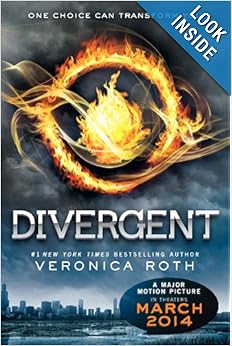
Divergent by Veronica Roth


‘There’s a difference between not being afraid and acting in spite of fear,’ Divergent, Ch12

Divergent by Veronica Roth is the first book of a trilogy. It is about a world where it is split into five factions: Erudite, Dauntless, Abnegation, Amity and Candor. Each year, 16 year olds have to choose only one of them to live in for the rest of their lives. Beatrice, one of these 16 year olds, struggles to make her decision, she can’t choose between family and where she feels like she truly belongs. In a world that’s supposed to be perfect, Beatrice sees the real truth. That nothing can stay perfect for long.

Divergent is a very well known book so that’s why I decided to read it. I was a little bit disappointed in the beginning of the book, because it didn’t capture my interest like I thought it would. There have been many positive comments on the book, so my expectations were very high.  The book didn’t get my interest right from the start, but after a few chapters it was definitely a page-turner.

Friday, 21 February 2014

Solace & Grief by Foz Meadows


Solace and Grief follows the story of a 17 year old girl called Solace. She was raised in a foster care, but when she finds out she is a vampire she is compelled to run away. Soon, she finds herself within a group of other strange young adults. They are part of ‘the Rare’ and each one of them has a ‘Trick’, which is a superpower or a supernatural ability. For example, Jess is a psychic reader, and Solace is a vampire. But soon things start to get a little weird... A Faceless man is stalking her and Professor Lukin is a bit too interested in their ‘Trick’...

This is the first book of a series called The Rare. It is set in Sydney, Australia and I found it interesting that Foz Meadows has used real places in the city but added twists to make them supernatural. At the beginning of the book, the story seemed to be droning on to nowhere. However, some things that seemed irrelevant at the start actually ended up being important towards the end. I didn’t like how Solace and her friends went to the Gadfly and got drunk, then stayed home all day. This seemed to happen several times, and I think it stalled the story a bit. Nevertheless I continued reading, and I’m glad I did.
I loved the variety of characters in the book. They all have different ‘Tricks’ and personalities. I found it a bit hard to remember who was who at the start, because a lot of characters are introduced all at the same time.

Monday, 10 February 2014

The Return of History and the End of Dreams by Robert Kagan


“When individuals have the power not just to dream, but to realize their dreams, they will demand a greater say.” – Bill Clinton


The Return of History and the End of Dreams by Robert Kagan is a long ‘essay’ on the study of geopolitics/economy of the ‘great powers’ after the Cold War. Kagan explores the main foreign policies and aims of the United States, Russia, China, Europe, Japan, India and Iran. According to Kagan, “Autocracy is making a comeback.” And, as the world goes back to ‘normal’ the hopes of the modern democratic world that, “wanted to believe that the end of the Cold War did not just end one strategic and ideological conflict but all strategic and ideological conflict” are diminished.

Surprisingly, I quite enjoyed this book. I say surprisingly because I have never read any book of this style. I had a sort of prejudice in my head before reading that I would find this all very dry and difficult to understand, this prejudice all went away when I started reading, and I found I am really interested in the field of geopolitics.

Saturday, 25 January 2014

Paladin by Dave Luckett

“Good if they were good, but they weren't always good... Power goes to most people’s head, you know.” (p. 27)

Paladin by Dave Luckett is the exploration of truth and justice by placing the protagonists into fantasy second dimension/world. Sam and Finny live as outcasts in their city, until they find out that they belong to another world. Both Sam and Finny have magical talents that are needed in to fight evil in another land.

Firstly, the novel was a pleasant short read but it wasn't a great book. Paladin isn't bad but it isn't very good either, it’s just mediocre. While, I enjoyed the hour or two it took me to read I wouldn't recommend this book, simply because there are other fantasy novels that are better. The main reasons for this were that it was very brief and unoriginal. However, there were some nice themes investigated.

Friday, 17 January 2014

Little Dorrit by Charles Dickens


“You will profit by failure, and will avoid it another time. I have done a similar thing myself, in construction, often. Every failure teaches a man something, if he will learn.”


Little Dorrit by Charles Dickens is the tale of the intertwining lives of 19th Century British families, from different social and economic statuses. Little Dorrit was born and raised in the Marshalsea debtors’ prison. She meets Mr. Clennam, who had just returned from his travels abroad, after his father died and left a mysterious watch for Mrs. Clennam. After seeing his mother being unusually nice to Little Dorrit he begins to suspect that his mother, the watch and Little Dorrit are all connected. He also suspects that his mother had taken some part in the financial state of the Dorrits. Mr. Clennam, with the help of friends and high powered connections investigate this case. What we find out in the end is a bigger twist to the story than Mr. Clennam ever suspected when he began to investigate.

Like many 19th Century, English classics, Little Dorrit is a humongous text that explores the unfair working of society, the gap in the upper and lower classes and especially, the obsession people have with money. I found this book was sometimes very confusing and at other times very intriguing. The start was very long and it only became to be interesting only a third of the way in, mostly because it was when I started to understand the story – others more proficient in classic literature may completely disagree with me. What I found the hardest to follow were all the jumps from each family every few chapters. However, I didn’t worry about this too much because I had already learnt from Les Miserables by Victor Hugo, which followed the same style. And as expected, the confusion all pays off when all the characters come together to form part of just one story.
Warning: This is a somewhat lengthy review  of the ideas on the book and it contains  some spoilers.