Pages

Friday, 17 May 2013

The Great Gatsby by F. Scott Fitzgerald


“The loneliest moment in someone’s life is when they are watching their whole world fall apart, and all they can do is stare blankly.”The Great Gatsby by F. Scott Fitzgerald is a classic American novel. The story is told by Nick as he shares his point on view of the people around him and of course, about the mystifying Gatsby. Gatsby, like the country, is young. Gatsby’s past mysterious, his stories don’t match up and the reasons he has done everything so far is unclear. Nick uncovers the truth, or at least what we think is the truth, of the man.I guess if you are reading this you want to know if it is a good book to read. Before I start discussing the novel and analyzing it, I will start by answering this. I have heard many people who have enjoyed this book, it is even being made into a movie but I wouldn’t recommend it to anyone.

I am Nujood, Age 10 and Divorced by Nujood Ali

‘Compared to dreams, reality can be truly cruel. But it can also come up with beautiful surprises.’
I am Nujood, Age 10 and Divorced is a real life story about Nujood Ali. She was a ten year old girl living in Yemen, a country in the Middle East. The quote above sums up what the whole book is about. Nujood had so many dreams; seeing the ocean, learning how to read and having a better life. However, her reality is completely different. When she was only 10, her father forced her into marrying a guy three times her age! Because of this, Nujood had to leave school and her family to live with him. She then suffered physical, emotional and sexual abuse from her husband every single day. A few weeks after her marriage, she ran away and went to the court. Although child marriage is common in Yemen, she was one of the first to file for divorce. After a long time, she finally managed to get divorced and go back to school.

Tuesday, 7 May 2013

We the Living by Ayn Rand

File:AynRand WeTheLiving.jpg
“To a life; which is reason unto itself.”  - Ayn Rand

We the Living by Ayn Rand is set in the early 1900s in the uprise of communism in Russia. Although it is about the U.S.S.R. the story is still relevant (as Rand points this out, in her foreword) because it is about totalitarianism and how humans should never think them above anyone else to have the right to decide who lives and who dies, because it is those that are fighting for life that deserve it and make progress and those who kill or live for others have much to learn. The plot revolves around Kira, a young woman who returns to her family home in Petrograd. Kira is very passionate about life and living it for her own sake, she dislikes the communists and yet she dislikes their enemies, she prefers to live not for a group but for herself. Kira studies at the institute to become an engineer. At the institute she meets Andrei Taganov. Andrei is a strong proletariat but starts developing feelings for Kira. However, Kira falls in love with a handsome stranger she met in the park at night time. This is the story of her own battle and struggles that she faces to become the woman she always wanted to be.


This book was amazing! It was captivating and had a nice love story, and yet it still taught a lot about Russia at the start of the Communist movement. There were some parts that I wished for  a 'glossary' at the end of the book or at least notes to explain some terminologies, however, the overall book was not so hard to understand. Just if someone has troubles understanding, here are the words I got stuck at,

Saturday, 27 April 2013

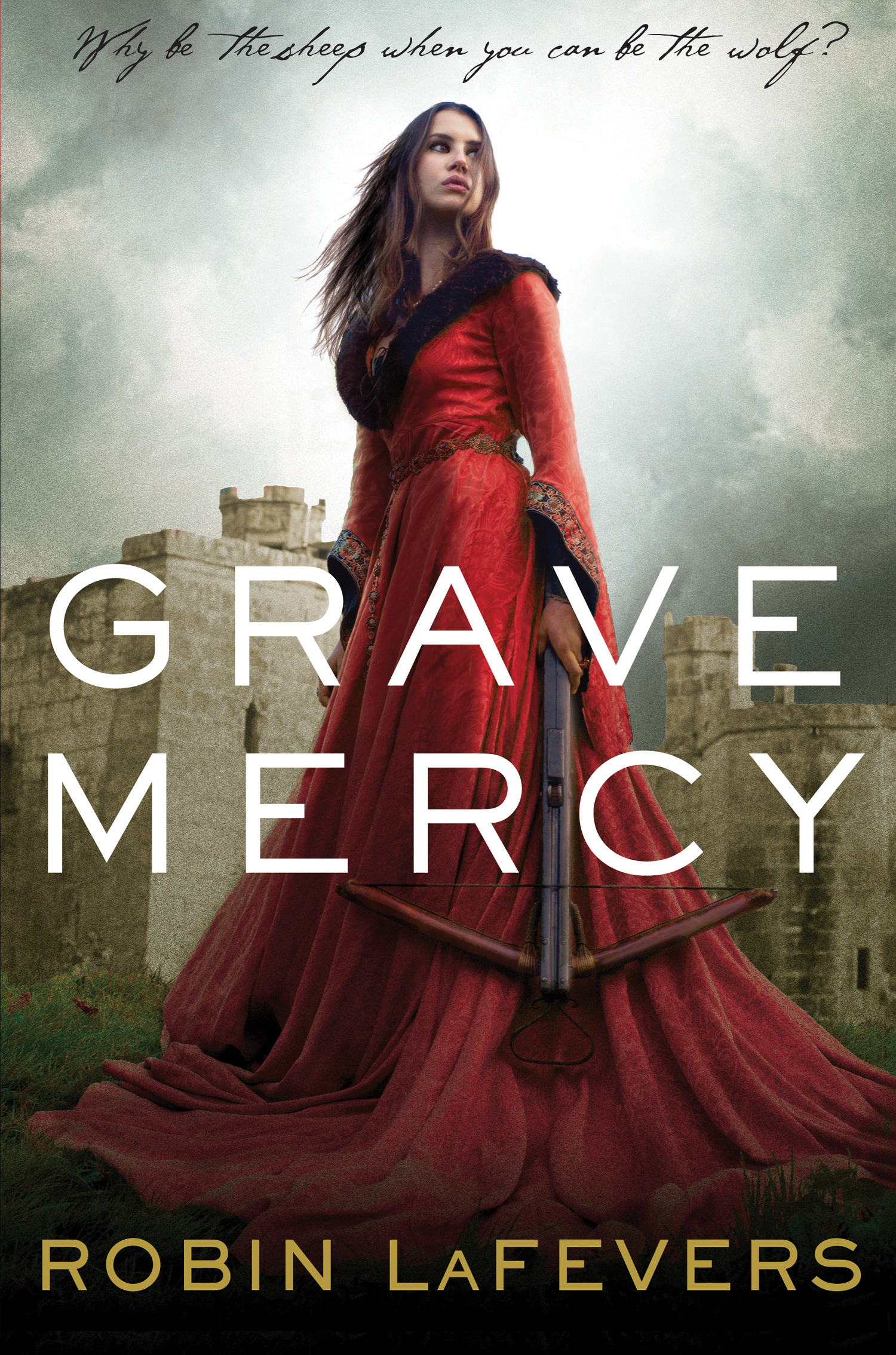
Grave Mercy by Robin LaFevers

“Why be the sheep when you can be the wolf?”  - Grave Mercy


Grave Mercy by Robin LaFevers is the first book in His Fair Assassin series. After escaping the brutalities of her father and her newly wed husband she is sent to a convent.There Isame learns that she is a daughter of death, just like the other girls of the convent of St. Mortain. She has been assigned a duty to kill those with a 'marque', to bring justice into the world. Ismae learns all the ways to kills a man and is ready for where her duties will take her. She has sworn loyalty to her God and convent to do their bidding. However,  everything is shaken when she starts falling in love with the man she is supposed to snoop and potentially kill. Also, she is starts to realise that maybe the convent can make mistakes.

To start off I have to say that this book is an older youth fiction; it is suitable to girls in their 20s. At the start I was a bit discouraged and thought that this book would be inappropriate for someone in their mid-teens. However, the book shifts in their focus, away from the villainy and brutality towards more of a mystery and romance novel. 

Although this book is all about an assassin, I think it can relate a lot to real life. The theme/idea that stayed with me through this book is one that I have always debated; the relationship between believing in religion and believing in the religion's faith.

Friday, 26 April 2013

Haunting Violet by Alyxandra Harvey


“Tucking my nose into a book makes me completely oblivious to my surroundings. I would have made a terrible spy in the army--the first person to hand me a novel would have been able to shoot my head clean off without me noticing.”  - Haunting Violet


Haunting Violet by Alyxandra Harvey is the story of Violet and her new abilities to see the dead in the midst of 19th century society. Her mother was a fake spiritualist with a great desire and ambition to join the rich and live in luxury. Violet must obey her mother and follow her schemes however everything changes when Violet finds that an assassinated young girl wants her to solve a real ghost mystery. 

I quite enjoyed reading the book and I found myself pondering if real life spiritualists really do exist. I'm sure many are like Violet's mother, lying and deceiving just for fame and money. However, the world has such a numerous population, I really do think that maybe at least one person actually has this ability to see and talk to the dead. 

While reading this book I realise I would have really liked to be able to go to the past an spend some time in that era; in the richer side of the population, of course. All the dresses, no matter how uncomfortable thy are described as, hold some appeal to me. I realise how girls were treated as having to be all polite and obedient and that the thoughts there were very much sexist but I would like to spend just a week in that time so I can wear those clothes and live in such grandeur and splendour, with so many people to take care of you. 

Spoilers Below!!!

Friday, 19 April 2013

Persuasion by Jane Austen


“How quick come the reasons for approving what we like.”  - Jane Austen,


Persuasion by Jane Austen is the story of Anne Elliot; a witty, independent and intelligent woman of the upper class in the 19th Century. Eight years before the start of the novel, Anne was still a young woman when she fell in love with Officer Frederick Wentworth. However, she was persuaded against this love. Now, in the present she is already 27 and much wiser. She meets again with now, Captain Frederick. This is not only their love story but also the satire of society’s vanity and social class.

At the start I found the book quite hard, I thought that I would actually be writing this review differently and saying that I didn't think this was a book for my level and age, mid-teens. The words were quite hard, like any other classic and the names sometimes got me confused, especially the two Charles and it didn't help they were cousins. However, once the story started taking shape the whole thing became easier to read and follow. 

I quite enjoyed this book, but I do have one comment that to me seems to correlate with Jane Austen’s literary work; I find that Austen writes books that if they were written nowadays they would have been considered ‘teen fiction’ with a bit of romance. It may be because I am used to the thrill of fantasy novels but I found that Persuasion didn’t have a very strong plot. As I said, I enjoyed reading the novel however, as I go over the story I don’t know how the story took over so many pages. It was basically the day to day life of Anne Elliot and her seeing Captain Wentworth again. There were little complications, like there would be in real life but nothing major. I read in the trusty J sparknotes that the climax was when Wentworth gave Anne the letter announcing that he still loved her.  However, this scene was one of the last in the books, were all the other 150 or 200 pages just the introduction and a very small build-up?

Saturday, 6 April 2013

Frankenstein by Mary Shelley


“Beware; for I am fearless, and therefore powerful.”  - From the novel, Frankenstein


Frankenstein by Mary Shelley is Gothic genre book written in the 1818. Victor Frankenstein is an university student whose ambitions and passion for the science leads him to create something no one has ever deemed possible, he created life using dead humans' body parts. However, as soon as he finishes his project he realises the mistake.To him, the monster is vile and gruesome. The story is told through the letters of Captain Robert Walton, who found Frankenstein nearly at a state of emaciation. His letter not only incorporates Victor's story telling but Victor's own letter and even the monster's side of the story as he tells it to Victor who then tells it to Walton. 

How do I begin..

The novel was completely different to what I imagined and it gets me so frustrated that the movies are so different to the book. I don't think Mary Shelley would have been too happy with the movies made of Frankenstein  not only because they are so different but because they lose the themes and morals. There are various movies that came out on Frankenstein but most of them have the Creature as some sort of complete monster who can't talk at all other than grunts. In the book Frankenstein was so eloquent and always gave an explanation as to why he became the way he was. In one of the movies the Monster was bad tempered was because the brain used was a criminal's brain, however in the book the Monster killed people because of the injustice that he suffered because of his appearance. Also, they even changed the name of Victor Frankenstein to Henry and made the character lose the feeling of isolation. In one of the movies there are sequels (eg. Frankenstein's Bride) but in the book Frankenstein died... I mean, I know movies are usually a bit different to books so that it flows more and scenes are changed so that emotions and reasoning are depicted visually rather than worded out but this is just ridiculous.